Why did my child get a minus number so early? Does myopia come from parents? Can the power keep increasing? Learn what childhood myopia means, why it can progress, and how modern myopia-management options—including specialised myopia-control spectacle lenses—are used to try to slow progression.
Myopia—often called short-sightedness, near-sightedness or a “minus number”—makes distant objects look blurred because light focuses in front of the retina rather than directly on it. In most childhood myopia, the eye has grown longer than ideal. Myopia can progress while a child is growing, especially when it starts at a younger age. Family history increases risk, but children with no myopic parents can still develop myopia.
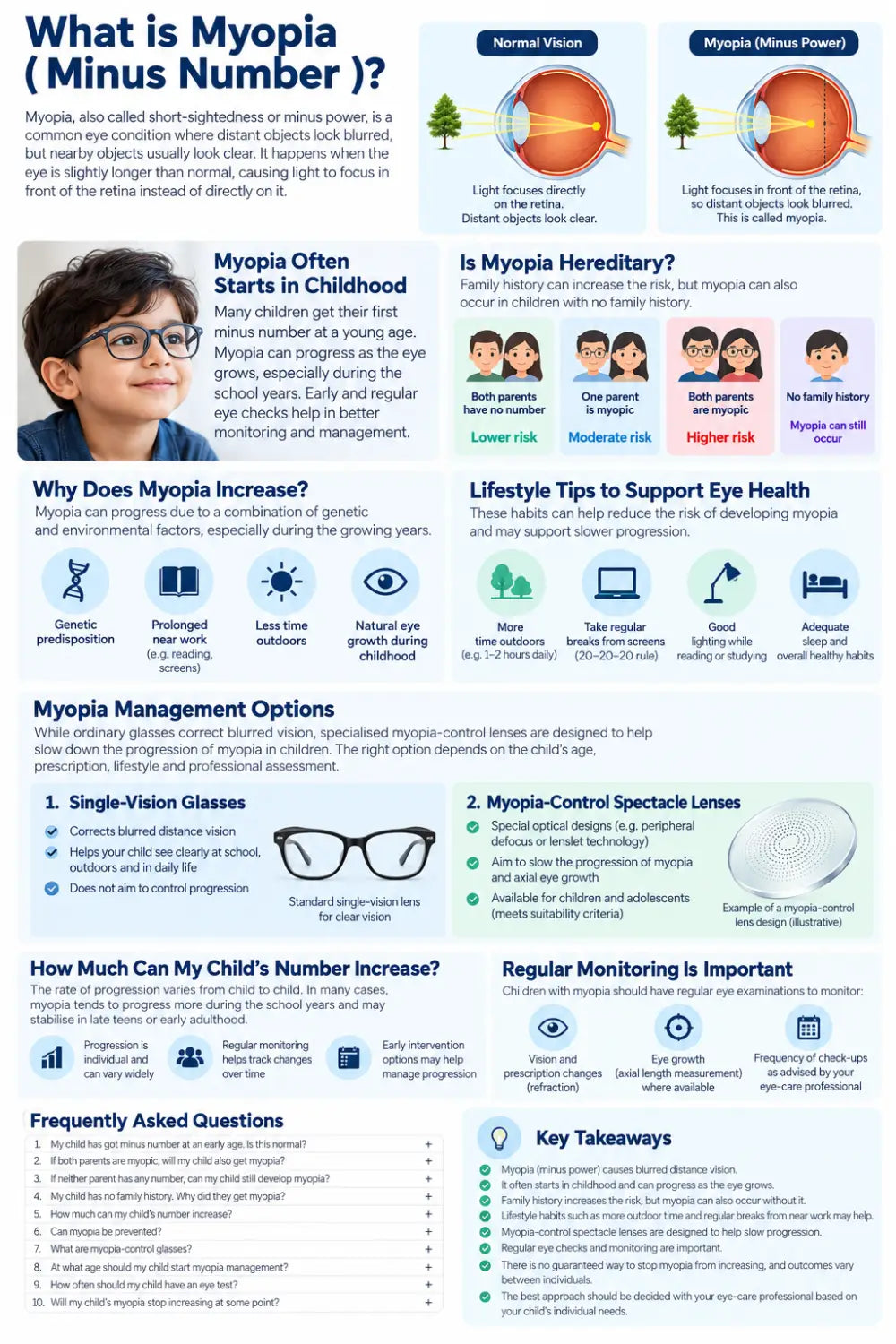
What Is Myopia or Minus Number?
Myopia is the medical term for short-sightedness or near-sightedness. In everyday optical language in India, families often call it a minus number because the spectacle prescription usually has a negative sign, such as -0.50 D, -1.00 D, -2.50 D or higher.
A child with myopia usually sees nearby objects more clearly than distant objects. Classroom boards, road signs, television subtitles or faces across a room may look blurred. Squinting can temporarily make distant details look sharper.
Most childhood myopia is associated with the eye growing too long from front to back—called increased axial length. When that happens, light focuses in front of the retina rather than directly on it. Ordinary minus-power glasses move the focus back onto the retina and make distance vision clear.
What does -1.00, -2.00 or -5.00 mean?
The number is measured in diopters (D). A more negative number usually means stronger myopia. For example, -3.00 D represents more myopia than -1.00 D. The prescription may also contain cylinder and axis values if the child has astigmatism.
“My Kid Got a Minus Number at an Early Age. Is That Normal?”
Childhood myopia is common and is becoming more common worldwide. AAPOS notes that myopia often worsens while children grow, especially during the school years, and may continue changing through the teenage years and sometimes into the early 20s.
The age at which myopia begins matters. A child who becomes myopic at a younger age has more years during which the eye can continue growing. Early onset is therefore associated with a greater chance of reaching a stronger prescription later.
This does not mean every young child with myopia will develop high myopia. It means early-onset myopia deserves regular monitoring rather than treating each new pair of glasses as an isolated purchase.
Does Myopia Come From Parents?
Genetics matter, but myopia is not determined by genetics alone. The International Myopia Institute identifies having one or two myopic parents as a risk factor, while environmental factors—particularly time outdoors and patterns of near work—also contribute.
1. Both parents are myopic
If both parents have myopia, the child has a higher risk of developing myopia than a child with no myopic parents. This does not mean the child is guaranteed to become myopic, and it does not tell you exactly how strong the final prescription will be.
2. One parent is myopic
A child with one myopic parent also has an increased familial risk compared with a child whose parents are not myopic. Lifestyle and visual environment still matter.
3. Both parents have no number
A child can still develop myopia even when neither parent wears minus-power glasses. Genetics are only one part of the picture. Modern changes in education, prolonged near work and reduced outdoor exposure are among the environmental factors associated with increasing myopia prevalence.
4. There is no family history of myopia
No family history does not rule out myopia. Many children who become myopic do not have an obvious family history. If a child is struggling to see the board, squinting, sitting unusually close to screens or television, or has failed a school vision screening, a complete eye examination is appropriate regardless of family history.
How Much Can My Child’s Minus Number Increase?
There is no reliable formula that can predict exactly how much an individual child’s prescription will increase. Progression varies with age, age of onset, baseline prescription, eye growth, family history, visual environment and treatment.
Some children change slowly; others can change noticeably over a year. Myopia-control clinical trials often study children whose prescription has shown meaningful progression, but a research threshold should not be used as a promise or forecast for an individual child.
AAPOS notes that myopia commonly progresses most during childhood and adolescence. Younger onset generally increases the lifetime opportunity for progression, which is why early monitoring is important.
What should parents track?
- The child’s full spectacle prescription at each visit.
- How quickly the spherical equivalent is changing.
- Axial length, if your eye-care professional uses it for myopia management.
- Whether the child is wearing the prescribed correction consistently.
- Daily outdoor time and patterns of prolonged close work.
- Whether a myopia-control treatment is being used consistently.
What Is High Myopia and Why Do Parents Hear About It?
AAPOS describes high myopia as approximately -6.00 D or greater, or an axial length above about 26.5 mm. Higher levels of myopia are associated with increased lifetime risks of retinal tears or detachment, myopic retinal changes, glaucoma and other eye problems.
This is why modern myopia management is not only about avoiding thicker glasses. The long-term goal is to reduce how much myopia and axial elongation develop when possible.
What Is Myopia Management?
Myopia correction and myopia management are not the same thing. The International Myopia Institute recommends using these terms distinctly.
| Approach | Main purpose | Example |
|---|---|---|
| Myopia correction | Makes blurred distance vision clear | Ordinary single-vision minus-power spectacles |
| Myopia control | Intervention intended to slow myopia progression or axial eye growth | Specialised myopia-control spectacle lenses, selected contact-lens designs, orthokeratology or medically supervised atropine |
| Myopia management | Ongoing strategy combining correction, monitoring, risk assessment, lifestyle guidance and appropriate control treatment | Regular refraction/axial-length monitoring plus an individualised intervention |
What Are Myopia-Control Spectacle Lenses?
Myopia-control spectacle lenses are specialised glasses designed not only to correct central distance vision but also to alter the optical signals reaching other parts of the retina. The aim is to reduce the stimulus associated with excessive axial eye growth.
You may hear generic technical terms such as DIMS (Defocus Incorporated Multiple Segments), HAL/HALT (highly aspherical lenslets), CARE (cylindrical annular refractive elements), peripheral-defocus lenses or lenslet myopia-control spectacles.
These are different optical designs, not simply ordinary “thin lenses,” “blue-cut lenses” or anti-glare coatings. In published randomized trials and recent reviews, several lenslet/peripheral-defocus spectacle designs have slowed refractive progression and axial elongation compared with ordinary single-vision spectacles in children. The amount of benefit varies between children, studies and designs, and treatment does not guarantee that progression will stop completely.
Do myopia-control lenses cure myopia?
No. They are intended to slow progression, not erase an existing minus prescription. The child still needs optical correction to see clearly.
Are all “myopia lenses” the same?
No. Different manufacturers use different optical geometries and fitting requirements. Commercial examples may use DIMS, highly aspherical lenslets or other peripheral-defocus strategies. Selection should be based on age, prescription, progression pattern, frame fit, binocular vision, availability and the recommendation of the child’s eye-care professional.
Can ordinary blue-cut glasses control myopia?
Blue-light filtering and myopia-control optics are different technologies. A standard blue-filter coating or blue-cut lens should not be assumed to slow axial myopia progression unless the lens has a specific evidence-based myopia-control optical design.
What Other Myopia-Control Options Exist?
Depending on the child, prescription, age, eye health and local availability, an eye-care professional may discuss options such as:
- Specialised myopia-control spectacle lenses using lenslets or peripheral-defocus designs.
- Multifocal / dual-focus soft contact lenses designed for myopia control.
- Orthokeratology (Ortho-K), rigid lenses worn overnight to temporarily reshape the cornea; contact-lens hygiene and infection risk require careful supervision.
- Low-dose atropine eye drops under medical supervision. The most appropriate concentration, formulation and regulatory status vary by country and continue to be studied.
- Combination treatment in selected progressing children under professional management.
Does Outdoor Time Help? What About Screens and Studying?
Outdoor time has one of the strongest evidence bases for reducing the risk of children developing myopia. The International Myopia Institute supports roughly two hours per day outdoors during daylight where practical, with appropriate sun protection. Evidence for slowing progression after myopia has already developed is less consistent, but outdoor time remains a sensible part of healthy visual habits.
Near work is more nuanced. Education and prolonged close work are associated with myopia risk. IMI guidance highlights very close reading distances and long uninterrupted periods of near work as patterns associated with greater myopia risk. Children do not need to stop reading or studying; the goal is sensible working distance, regular breaks and avoiding unnecessarily prolonged close viewing.
What parents can practically do
- Encourage regular outdoor activity during daylight.
- Avoid holding books, phones or tablets extremely close to the eyes.
- Build breaks into long homework or screen sessions.
- Ensure good lighting for reading and studying.
- Make sure prescribed glasses are worn as advised rather than deliberately under-correcting the child.
- Keep scheduled eye examinations even when the child says the glasses still feel “fine.”
When Should a Child Start Myopia Management?
There is no single age or minus number at which every child should start the same treatment. The decision depends on confirmed myopia, age of onset, documented progression, family history, axial length where available, visual needs and the suitability of specific treatments.
Because younger onset is associated with a greater risk of stronger myopia later, parents do not need to wait until the prescription becomes “very high” before asking about myopia-management options. An early discussion allows the eye-care professional to establish a baseline and monitor change.
What Eye Test Does a Myopic Child Need?
Children should receive a complete eye examination rather than relying only on a quick spectacle-power check. AAPOS recommends accurate refraction in children, often using cycloplegic eye drops so the child’s strong focusing system does not mask the true prescription.
Depending on the clinical setting, a myopia-management assessment may also include binocular-vision evaluation, corneal measurements and axial-length measurement.
Frequently Asked Questions Parents Ask About Childhood Myopia
My child got a minus number at an early age. Should I worry?
Early-onset myopia deserves regular monitoring because younger children have more years during which the eye can continue growing. It does not mean severe myopia is inevitable, but it is a good reason to ask about myopia management rather than only replacing glasses when the power changes.
Both parents are myopic. Will my child definitely get myopia?
No. Having two myopic parents increases risk, but it does not guarantee that a child will become myopic or predict the final prescription. Environmental factors also influence risk.
Only one parent has a minus number. Is my child at risk?
Yes, family history with one myopic parent is still a recognised risk factor, although the child may or may not develop myopia.
Both parents have no number. Why did my child still get myopia?
Myopia is multifactorial. Children can develop myopia without myopic parents. Education, prolonged near work, outdoor exposure and individual eye growth all contribute alongside genetics.
There is no family history of myopia. Can my child still become highly myopic?
Yes, although family history is an important risk factor, it is not the only one. Early onset and continued progression are important reasons for regular monitoring regardless of family history.
How much can my child’s minus number increase in one year?
There is no fixed amount. Progression varies considerably between children and tends to be faster at younger ages. Your eye-care professional should compare serial refractions and, where used, axial-length measurements rather than predict progression from one examination.
Will my child’s number keep increasing every year?
Not necessarily at the same rate. Myopia commonly progresses through childhood and adolescence, then often slows as growth settles. The timing varies from person to person.
Can myopia stop increasing on its own?
Progression often slows in the later teenage years or early adulthood, but there is no exact age at which it stops for every person.
Can myopia be reversed or cured?
Established childhood myopia is generally managed rather than “cured.” Glasses correct the blur, while myopia-control treatments aim to slow further progression. They do not reliably reverse existing axial elongation.
Do regular glasses stop myopia from increasing?
Ordinary single-vision glasses correct blurred vision but are not specifically designed to control progression. Specialised myopia-control spectacles use additional optical design elements intended to slow progression.
What are myopia-control glasses?
They are spectacle lenses that provide clear central vision while incorporating additional optical zones or lenslets intended to influence peripheral retinal focus and reduce signals associated with excessive eye growth.
Do myopia-control lenses actually work?
Multiple randomized trials and systematic reviews show that several modern spectacle designs can slow average myopia progression and axial elongation compared with ordinary single-vision lenses. Individual response varies and progression can still occur.
What are DIMS lenses?
DIMS means Defocus Incorporated Multiple Segments. It is a spectacle-lens design that combines a clear central correction zone with multiple surrounding segments that create myopic defocus.
What are HAL or HALT myopia-control lenses?
These designs use highly aspherical lenslets around the central correction zone to create an optical signal intended to slow eye growth. They are one of several evidence-based spectacle approaches studied for childhood myopia.
Is a blue-cut lens the same as a myopia-control lens?
No. Blue-light filtering and myopia-control optical designs have different purposes. A conventional blue-filter lens should not be assumed to control myopia progression.
Does more screen time increase my child’s minus number?
Screen use is one form of near work. Research links prolonged close work and less outdoor time with myopia risk, but screen use alone is not a simple one-to-one cause. Working distance, uninterrupted near time and outdoor activity all matter.
How much outdoor time should a child get?
International myopia guidance commonly encourages around two hours of daylight outdoor time per day where practical. Outdoor time has particularly strong evidence for delaying myopia onset.
Should my child wear glasses all day?
Children should generally wear their prescribed myopic correction as advised by their eye-care professional. Deliberately under-correcting myopia is not a recommended strategy for slowing progression.
At what age can myopia-control lenses be started?
There is no one age for every design or every child. Suitability depends on the child’s age, confirmed myopia, progression, prescription, visual needs and the specific lens technology. Early-onset myopia is a reason to discuss management promptly.
Do both eyes always increase at the same rate?
No. The two eyes can progress differently. This is another reason prescriptions and eye growth should be monitored individually.
My child’s power increased even after using myopia-control lenses. Does that mean they failed?
Not necessarily. Myopia-control treatments aim to reduce the rate of progression, not guarantee zero change. Progression should be compared with the child’s previous rate, axial growth and expected pattern under professional supervision.
Is myopia management only about spectacle lenses?
No. Depending on the child, options can include specialised spectacles, selected soft contact lenses, orthokeratology, low-dose atropine under medical supervision, lifestyle advice and sometimes combination treatment.
How often should a myopic child have an eye check?
AAPOS states that most children with myopia need at least yearly eye examinations, while children receiving active myopia-control treatment may need more frequent review and testing.
When should parents seek urgent eye care?
Sudden flashes, a shower of new floaters, a curtain or shadow in vision, sudden vision loss, severe eye pain or trauma require prompt professional assessment. These symptoms should not wait for a routine spectacle appointment.
Continue learning
Explore Kids & Myopia in the Education Centre.
Browse kids eyewear with your child’s fit and prescription in mind. Read the ZEISS myopia-control lens guide and ask about an assessment and suitable lens options before choosing.